
2026-01-20 · 8 min read
IntermediateGold Just Went on a Tear: The Reasons Behind the Rally
Gold prices surged through 2024–2025. Here’s what drove the rally and how to invest without buying a bar.
(No, not from the song.)
Gold has been on an absolute run recently.
While everyone’s been doomscrolling headlines about wars, AI, crypto, and “is the economy cooked?”, gold has been quietly (and then not so quietly) climbing to record highs.
If you’ve seen gold prices and thought: ”Wait, gold still matters?” My friend who’s up 120% on gold would maybe, probably, say yes. But a key takeaway in the last two years has been a reminder that gold is still the original ‘I don’t trust anything’ asset.
Let’s break down what happened, why it happened, and how a student/young adult can invest in gold without buying a literal bar and hiding it under the bed.
The numbers
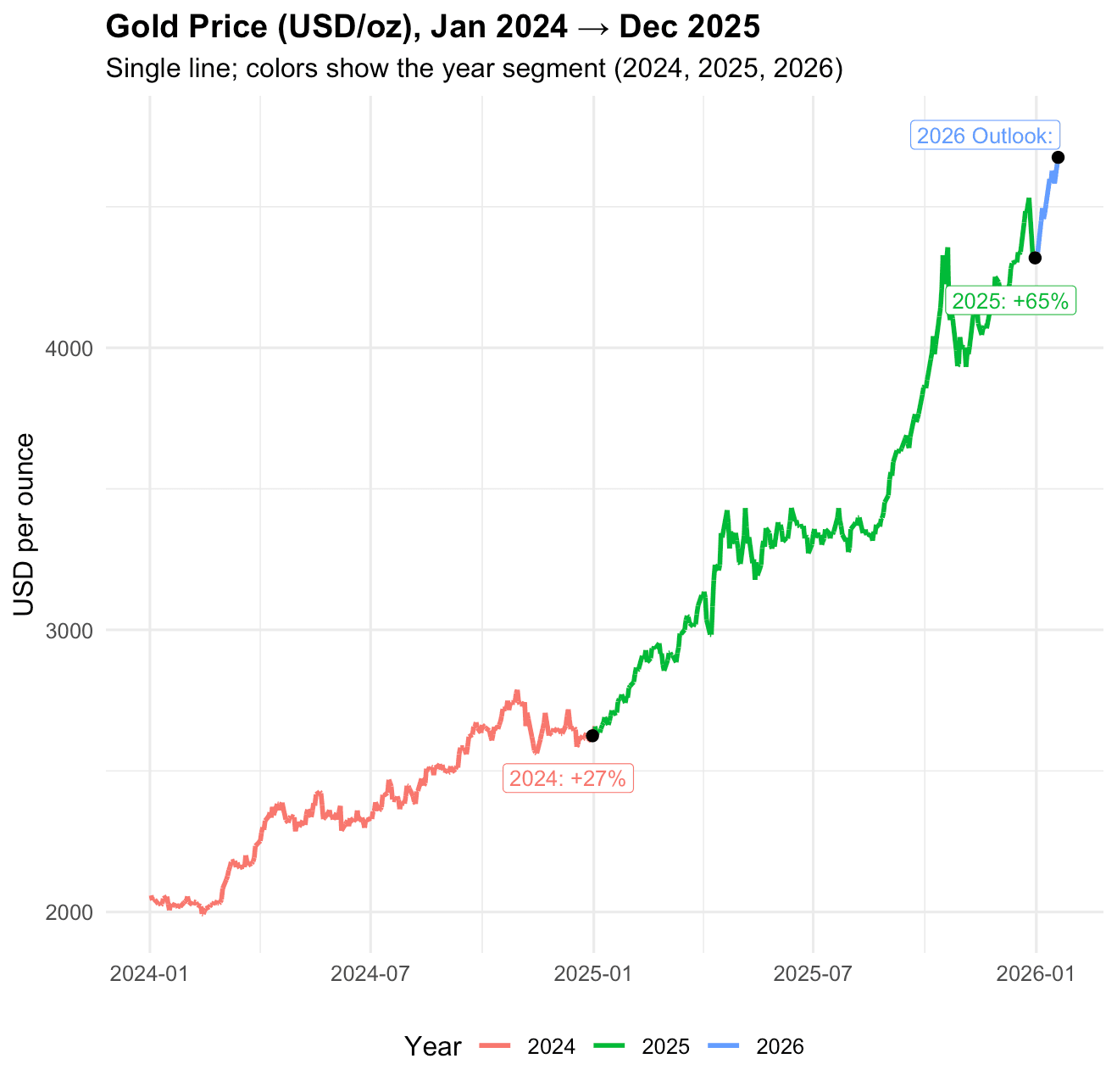
Here’s the headline: gold ripped through 2024 and 2025.
- 2024: Spot gold was up ~27% (one of its biggest yearly jumps since 2010), and it hit 40 record highs during the year.
- 2025: Gold finished the year up ~65% (wild).
- Early 2026: As of the day I am writing this, Gold is up ~159% in 3 years. Compared to the S&P 500’s return of ~73% in the same period, that is incredible!
- Future: Gold still started the year still running hot, with major banks talking about $5,000+/oz (USD, or about $6950 CAD) as a real possibility.
Why gold has been on a bull run (the 4 biggest drivers)
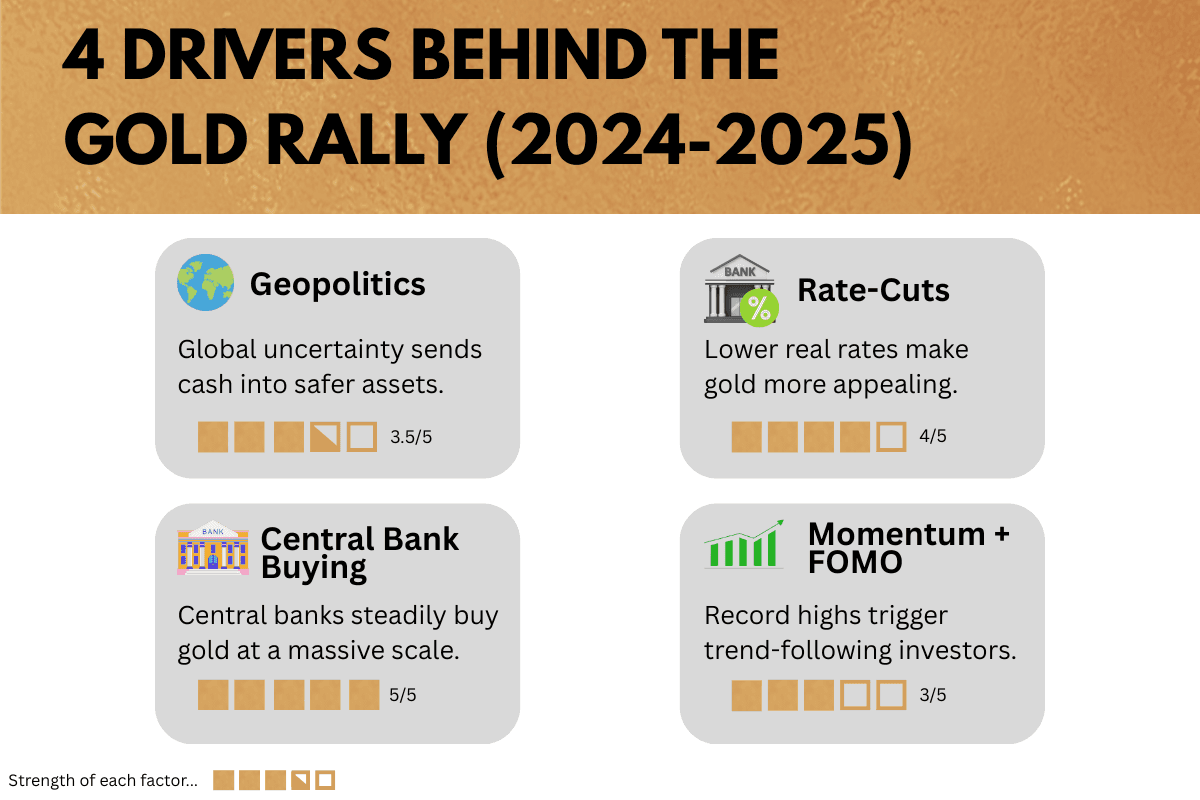
Gold didn’t go up because of one headline. It went up because a bunch of “risk signals” stacked up at the same time. And well, as it turns out (who would’ve thought) gold is basically the asset people run to when they don’t trust the vibe.
1) Geopolitics + global uncertainty
Gold’s most famous job is being the safe haven asset: the thing people buy when the world looks shaky. In 2024–2025, the world gave investors plenty of reasons to feel shaky: ongoing wars, conflict risk, and more political uncertainty than anyone asked for.
Reuters (British News Agency) and the World Gold Council both highlighted that gold prices were supported by geopolitical tensions and uncertainty, which pushes investors toward safety instead of riskier assets.
Why this matters:
When you don’t know what tomorrow’s headline is going to be, you’ll feel less comfortable putting your hard earned money into growth stocks and more likely to hold something that’s historically held value for centuries.
Money Campus version:
When the world gets messy, gold becomes the storm shelter for money.
2) Rate-cut expectations + real rates (macro stuff, but I’ll try to explain it simply)
Gold doesn’t pay interest. So normally, when interest rates are high, people can earn decent returns from boring assets like bonds or even savings accounts, and then by default gold looks less attractive by comparison.
But once markets started pricing in rate cuts, or at least lower rates coming eventually, gold got a boost. A lot of 2024 coverage pointed to expected shifts in monetary policy and ultimately results as a reason gold climbed.
The other key idea is real rates (interest rates minus inflation). If inflation is still, you know, annoying, and rates aren’t beating it by enough, then gold starts looking better as a store of value.
Why this matters:
Gold tends to like environments where:
- rates are falling, or
- inflation is stubborn, or
- both :)
Money Campus version:
If cash and bonds stop paying more than desirable returns, after inflation, gold looks more worth holding.
3) Central banks buying it up like it’s Costco bulk
This one is huge and most people don’t talk about it enough.
Central banks, or countries’ official reserve managers, have been buying massive amounts of gold. Reuters reported that central banks purchased over 1,000 tonnes again, for the third year in a row by the way, which is a huge steady stream of demand.
Why would central banks do that? A big reason is diversifying away from the U.S. dollar (also called “de-dollarisation”). If you’re a country that doesn’t want all your savings tied to another country’s currency and political decisions, gold becomes an appealing neutral reserve asset.
Why this matters:
Central bank buying is powerful because it’s:
- large scale (billions of dollars)
- consistent (not just the hot trend of the week)
- long-term (they’re not day-trading)
Money Campus version:
When the big money in the world are stacking gold quietly, it puts a floor under the price.
4) FOMO + momentum
Once gold started breaking record highs, it got attention. Attention leads to more buyers. More buyers leads to higher prices. Higher prices lead to more headlines. And the cycle repeats.
This is the same basic momentum effect you see in any stock, or meme coins ;), except gold’s story is easier for people to understand; allow me:
“Inflation bad. War bad. Dollar instable. Gold good.”
Also, gold doesn’t have the same sell pressure as some other assets because a lot of gold holders treat it like insurance and not a trade. If you buy gold as portfolio protection, you’re not rushing to sell the moment it’s up 10%.
Why this matters:
Momentum makes bull runs stronger, because markets don’t move solely on logic. They move on:
- emotion
- fear
- trend-following
- herd behavior
Money Campus version:
Gold started running, people noticed, and then the “I don’t want to miss this” crowd showed up.
Now enough about the hype, how does one go about buying gold?
You don’t need a suit, a finance degree, or a vault.
Option A: Wealthsimple Physical Gold
Just a few months ago, Wealthsimple now lets you buy physically-backed gold inside your account, fractional amounts, full ounces, cool Wealthsimple coins, bars, whatever you want, starting as low as $1, with 24/7 trading.
The system they have in place is best explained as a fractional digital interest in physical gold reserves, stored at the Royal Canadian Mint and Brinks, with a 1% fee to buy and 1% to sell, and no ongoing storage fee.
You are able to set-up automatic recurring orders of any amount of this physical gold, and when you have purchased enough (5 or 10 ounces), you can trade it in straight from the app and Wealthsimple will mail you a gold coin.
Easiest gold exposure out there.
Reality check: If you buy and immediately sell, that’s ~2% round trip in fees. This isn’t for flipping.
Option B: Gold ETFs
Gold ETFs are basically “buy gold like a stock.” Easy to hold in any trading account, easy to buy and sell, and you don’t need to store anything.
Some Canadian options:
- CGL / CGL.C (iShares Gold Bullion ETF) (physically backed; 0.55% MER).
- ZGLD (BMO Gold Bullion ETF) (0.28% MER).
- MNT (Royal Canadian Mint – Canadian Gold Reserves) (old school, 16% premium charge but were the first to allow trading in for physical gold coins).
Sidenote: Yes, technically choosing an ETF like CGL and ZGLD have lower fees than the Wealthsimple option, however these ETFs never track the gold prices 1:1 and always have a little discrepancy. This is the reason the product has 1% buy and sell fees, along with a physical conversion option.
Best for: “I want gold in my TFSA and I want it low-maintenance.”
Quick tip: Look at fees (MER) and whether it’s CAD-hedged vs non-hedged (currency can change your return).
Option C: Physical gold (coins/bars)
This is the classic route, you own the actual metal. You can buy physical gold bars and coins from banks, specialized bullion dealers like The Mint, pawn shops, and fun fact: Costco actually sells 1 ounce gold bars through their online website (with a valid membership of course), and yes! The price is still very competitive.
One of the biggest downsides to investing in physical gold is you should buy insurance, and it is highly encouraged. Along with the risk of theft and damage, and the cost of storing it properly.
Best for: “I want something tangible.”
Downsides: Storage, insurance, spreads, and it’s not as easy to sell quickly.
Predictions for gold in 2026
Gold forecasts are basically educated guesses, but the big theme heading into 2026 is this: a lot of major banks think gold can stay strong if rates drift lower, uncertainty stays high, and central banks keep buying. JPMorgan (Investment Bank, largest bank by market cap in the world) expects gold to average around $5,055/oz in the last quarter of 2026, and another Reuters piece noted that $5,000/oz is “into view” for 2026 as banks raised targets.
In my opinion, with all the uncertainty pertaining to geopolitical implications in recent times, people have more trust in storing their money in gold rather than stocks.
So the vibe for 2026 is: still strong… but expect volatility (big swings up and down can happen even in a bull market).
Final words and conclusion
Gold’s run in 2024–2025 wasn’t random, it was the result of:
- uncertainty,
- rate expectations,
- central bank buying,
- and a little bit of market psychology.
If you’re a student or young adult, gold doesn’t have to be your main investment. It can be a smart small slice of your portfolio. Remember, diversification reduces risk!
Money Campus takeaway:
If gold helps you stay invested and sleep better during chaos, that’s a win. Just don’t treat it like a meme coin.
Quick Disclaimer
This content is for educational purposes only and is not financial, legal, or tax advice. Investing involves risk, including the possible loss of principal. Past performance does not guarantee future results. Always do your own research and consider speaking with a qualified professional before making investment decisions.
References
- Reuters (Feb 5, 2025). Gold demand up in 2024 + price up ~27% + central bank buying over 1,000 tonnes.
- Reuters (Oct 23, 2025). JPMorgan sees ~$5,055 average by Q4 2026.
- Reuters (Jan 13, 2026). $5,000/oz in 2026 “into view” as banks project upside.
- Wealthsimple. How Wealthsimple physical gold works (fractional, 24/7, $1 minimum).
- World Gold Council. Gold Demand Trends: Full Year 2024 (pricing records + demand context).
- World Gold Council. AI/electronics + gold’s tech demand notes.
Leave feedback
Anonymous and quick — your thoughts help shape future guides.
Recommended next reads
9 min read
The Economics of Starbucks
Starbucks isn't a coffee shop, it's a bank. And every time you reload your app, you're making a deposit worth $2.2 billion; to them.
5 min read
No Credit History? Here's How to Build It From Zero
A practical, Canada-specific guide for students and young adults on how to establish credit history from zero, covering authorized users, student cards, secured cards, and the habits that actually move the needle.
7 min read
Why Did Gas Get So Expensive So Fast?
Gas prices jumped 40 cents a litre in a matter of weeks. Here's the step-by-step chain that runs from a narrow waterway in the Middle East all the way to your receipt at the pump: including the part where Canada's biggest oil producer ends up on the wrong side of the equation.