
2026-01-08 · 5 min read
IntermediateYour First Investing Plan: One Account, One ETF, One Habit
No hype, no stress. Just the easiest way to start investing with any budget and low fees.
If you’ve ever said I should probably start investing… this is your sign.
If you’ve got a phone, a bank account, and literally any amount of money (yes, even $10–$25), you can start investing today. This guide is built for long-term, low-risk, mostly automated investing, geared towards people who don’t want to treat this as a chore. Think: calm, consistent, grown-up money moves.
No WallStreetBets shenanigans here. Boring is the goal; because boring tends to work best.
What you’ll learn
- Which investing accounts matter in Canada (TFSA, FHSA, RRSP, non-registered)
- What happens if you over-contribute (and how to avoid it)
- ETFs vs individual stocks (simple definitions + why you should care)
- How fees (MER) quietly eat your gains over time
- The simplest “set it and forget it” strategy (with dollar-cost averaging)
We’ll go deeper later (individual stock research, sector bets, higher-risk strategies, etc.). For now: foundation first.
Step 1. Pick the right account (Canada)
Here’s the cheat sheet.
| Account | Best for | Tax perk | Contribution starts… | If you go over the limit… |
|---|---|---|---|---|
| TFSA | Most beginners, general investing goals (what I prioritize) | Growth + withdrawals are tax-free | You start accumulating room when you’re 18 and a Canadian resident, even if you never opened one | 1% tax per month on the excess until fixed |
| FHSA | Saving/investing for a first home (can only be withdrawn with qualifying home purchase) | Contributions are generally tax-deductible, growth + eligible withdrawals can be tax-free | Your $8,000/year participation room begins the year you open the FHSA | 1% tax per month on the excess (can’t be fixed, as you can’t withdraw whenever you want) |
| RRSP | Retirement investing + tax deductions now | Contributions reduce taxable income (tax paid later when withdrawn) | Room is based on income (and shows on CRA notice of assessment) | 1% tax per month on unused contributions over your limit by more than $2,000 |
| Non-Registered (taxable) | When registered accounts are maxed, or for extra investing | No special benefits, you get taxed end of story | Anytime (but need to be 18 to open the account) | No contribution limit, but you pay tax on earnings |
TFSA (Tax Free Savings Account) example, in numbers cause words suck
TFSA annual limit for 2026: $7,000
You get new room every Jan 1, even if you never opened a TFSA.
Example: You turned 18 in 2023 (and were a Canadian resident). Your total room by Jan 1, 2026 would be:
- 2023: $6,500
- 2024: $7,000
- 2025: $7,000
- 2026: $7,000
Total available room = $27,500
(Your real number can differ if you’ve contributed/withdrawn before, or if residency changes.)
Important: CRA contribution room reporting will lag. CRA notes TFSA records from 2025 are processed by April 2026, so please, I highly recommend tracking your own deposits.
FHSA (First Home Savings Account): the key detail people miss
- In the first year you open an FHSA, your participation room is $8,000.
- Then you get another $8,000 each year after opening (as long as you stay within the rules).
- Lifetime FHSA deduction cap is $40,000.
So yes, even though you are 22 years old and have just opened an FHSA, your contribution limit is $8,000. Open the account even though you are not planning to contribute straight away.
Non-registered: how taxes work (simple version)
- Non-registered just means: no tax shelter.
- Interest income (like from savings interest or some distributions) is fully taxable as income.
- Dividends can qualify for a dividend tax credit (still taxable, just treated differently).
- Capital gains: you report them when you sell at a profit, and only a portion is included in taxable income (rules can change over time, so always check the current CRA guidance).
Step 2: Use a platform that won’t quietly drain you
You’ll see tons of options (including investing inside the Big 6 bank apps). Convenience is nice, but the real danger for beginners is usually fees.
What is MER? (and why you should care)
MER = Management Expense Ratio. It’s the annual fee inside a fund (mutual fund or ETF) that covers management + operating costs. It isn’t just deducted from your account like a bill, it’s taken from the fund, which lowers your returns.
Translation: A 2% MER doesn’t sound huge… until it compounds against you for years.
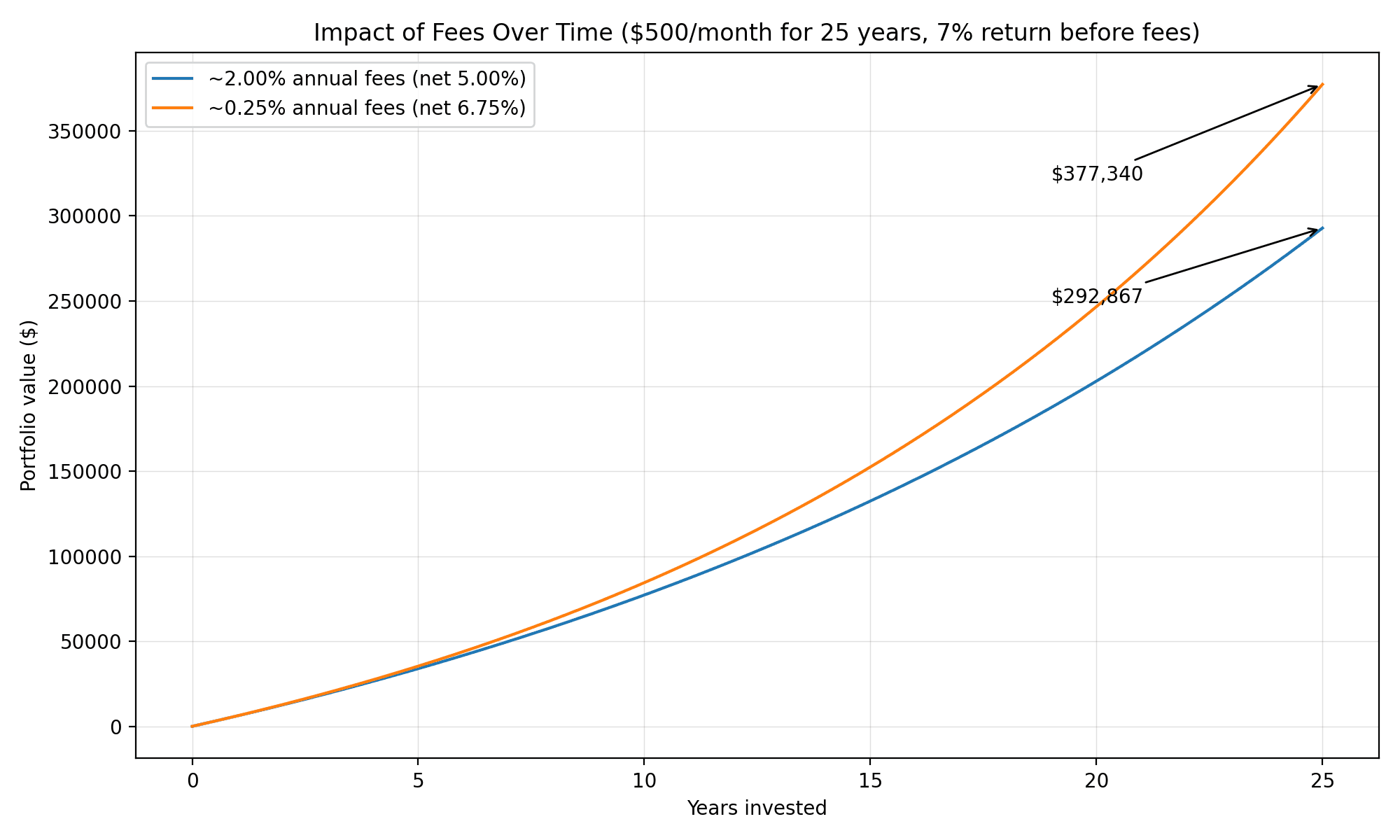
The “fees wreck your future” example
Let’s compare:
- A higher-fee fund: 1.91% MER (example: TD Comfort Balanced Portfolio fund facts show 1.91% MER)
- A low-cost ETF: 0.24% MER (example: VGRO ETF facts show 0.24% expenses/MER)
Now assume you invest $500/month for 25 years, and assume the markets return 7%/year before fees:
- With ~2.00% fees: you end with about $297,755
- With ~0.25% fees: you end with about $389,373
That’s roughly $91,618 more… from doing basically nothing except paying lower fees.
The solution? Where Wealthsimple + Questrade fit in
Popular “start investing” platforms (like Wealthsimple and Questrade) tend to make it easier to open accounts online, buy ETFs, and automate contributions.
The key feature you want as a beginner is automation (so you don’t rely on motivation). Some platforms let you set an automatic investing schedule (pick amount + frequency + what to buy), which is perfect for the strategy below.
Step 3: ETFs vs individual stocks (definition + why we care)
The real definitions
- ETF (Exchange-Traded Fund): a basket of investments (often hundreds or thousands of stocks/bonds) that trades like a stock.
- Individual stock: one company.
The dumbed-down version
- ETF = basket of fruits
- Single stock = orange
Why you should care
- ETFs usually give you instant diversification (less risk).
- Single stocks can outperform… or absolutely disappoint. They require more research, and mistakes cost more.
For most beginners, ETFs are the easiest way to invest without needing to become a finance detective. Some of the big names out there include: VFV (S&P 500), XEQT/VEQT (All-in one ETF), QQC (NASDAQ).
The simplest set-it-and-forget-it method
Here’s the boring plan that wins for a lot of people:
- Open a TFSA (or FHSA if you’re eligible and home is the goal).
- Choose one diversified, low-cost ETF that matches your risk comfort (stocks vs bonds mix).
- Set up auto-deposit every payday (or monthly).
- Set up auto-buy of that ETF on the same schedule.
- Ignore the noise. Check in occasionally, not daily.
That’s it.
How much do you need to start?
Whatever you can do consistently. $25/month beats $0/month. The secret isn’t the amount, it’s that you started, and you keep going.
Later on, we’ll talk about riskier + more complex stuff (stock picking, sector ETFs, higher volatility plays, and how to actually analyze companies). But you don’t need any of that to build a strong base.
TL;DR
- This is long-term investing, no meme-trade chaos.
- TFSA is usually the best starter account; room accumulates even if you didn’t open one yet.
- FHSA gives you $8,000/year starting when you open it (up to $40,000 lifetime).
- Don’t over-contribute: TFSA/FHSA penalties are 1% per month on the excess.
- ETFs = diversified basket; stocks = one company.
- Fees matter: a ~2% fund vs ~0.25% ETF can cost you tens of thousands over time.
Quick disclaimer
This article is for educational purposes only and isn’t financial, tax, or legal advice. Always do your own research and consider speaking with a qualified professional for your situation.
Leave feedback
Anonymous and quick — your thoughts help shape future guides.
Recommended next reads
4 min read
The Most Powerful Force in Personal Finance (And How to Use It)
Compound interest is the single most important concept in personal finance. It builds wealth silently when you invest, and destroys it just as quietly when you carry debt. Here's how it actually works, with real numbers.
6 min read
The Importance of Emergency Funds
Emergency funds are the boring, but essential money buffer that keeps you out of debt when life throws you a curveball.
8 min read
Growth vs. Dividend Investing: Which Style Is Actually for You?
Two different philosophies, one goal. Here's what dividend and growth investing actually mean, how they play out in Canada, and which one fits where you are right now.